
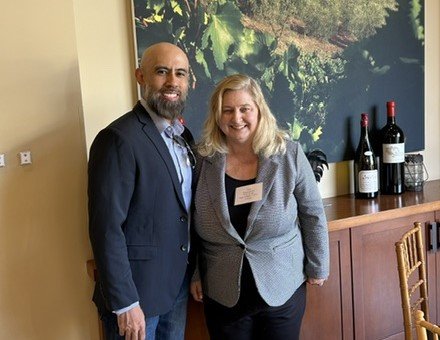


“Will I be replaced?” It’s a common question asked as the technological advancements of artificial intelligence (AI) continue to penetrate and disrupt all sectors. This includes the financial industry, which was a topic discussed at a May social event sponsored by Women in ETFs (WE) and the CFA Society of Orange County (CFAOC).
Moderator Jane Edmondson (TMX VettaFi’s head of index product strategy and co-head of women in ETFs, SoCal chapter) was jointed by industry veterans Julia Bonafede, CFA (president, JobsPeak Advisors), Lu Yu, CFA (managing director, lead portfolio manager at Virtus Systematic), and Jon Cook (founder of Keynote Content). The panel discussed the implications of this technological surge on the financial industry, and to hopefully answer the question everyone in the room has pondered at one point: Will AI replace me one day?
See More: 5 Infographics to Better Understand Artificial Intelligence
The AI Build-Out
To begin the speaking session followed by questions from the attendees, Edmondson set a sobering stage. She noted that since the launch of ChatGPT in late 2022, about $1.5 trillion has been directed toward AI deployment. To understand the scale of this financial commitment, she emphasized that this figure matched the projected 2027 U.S. defense budget.
Moreover, tech giants are driving up their capital expenditures (capex) and depleting cash reserves at a rapid clip while taking on additional debt to fund this AI buildout phase. Household tech names like Amazon, Microsoft, and Google are projecting nearly $800 billion in aggregate capex spending.
To realize the potential of AI, there is one implication that can’t be noted on a balance sheet: the human cost. As of May 2026, Edmondson noted that approximately 49,000 layoffs have been attributed to AI integration just this year.
Why Humans Still Matter
Despite this, the panel agreed that the financial sector remains a leader in both adoption and evolution. For Yu, AI isn’t a fad, but more of a refined tool. Having launched an AI factor in 2020 based on Google’s Attention is All You Need paper, Yu noted that AI has fundamentally changed how quantitative-focused finance professionals (or “quants”) process unstructured data. Yu shared an example of how AI sentiment analysis helped her team navigate the 2022 geopolitical crisis.
“Our AI sentiment factor pointed out that Russian stocks actually deteriorated quite a bit,” Yu said, noting that by the time Russia invaded Ukraine, her investment team had exited their positions.
“Our model and our optimization process immediately told us, ‘If you still want energy exposure, you don’t have to stick to all these energy companies in Russia, you can go to Petrobras in Brazil,’” she added.
Of course, a recurring theme was whether the proliferation of AI would render the human advisor or portfolio manager obsolete. Bonafede, an early adopter of deep reinforcement learning, emphasized that while AI is adept at extracting nonlinear patterns, it’s unable to replicate rigorous human oversight. She warned against “garbage data” and the decay of AI responses over time.
Cook, who consults with financial advisors, argued that AI should be viewed as an “intelligent data mesh” that works with, rather than against, advisors. By automating manual tasks like CRM updates and note-taking, AI empowers advisors to focus on the “human side” of the advisory business such as legacy planning and crisis management.
“When we remove the advisor from the equation of any technology, the clients suffer,” Cook asserted.
AI Will Supplement, Not Replace
The panel concluded that the future of finance will surround augmentation. Rather than paint an apocalyptic image touting the rise of the machines against the human race, the panel steeped their thoughts in reality.
For the next generation of financial professionals, the technical ability to prompt a machine will be secondary to the requisite financial knowledge required to verify its output. As Bonafede noted, the industry is entering a “full retraining effort.”
Success in this nascent, but rapidly evolving, era of AI will belong to those who use AI to eliminate mundane tasks. This will free up humans to do what they do best: be human.
“I still believe our capability to think, to have our own critical thinking, to be creative, will have us ahead of all the machines that we created,” Yu said.
Summarily, for those in the financial industry working alongside AI, the tech will serve as a supplement rather than a replacement for humans.
Originally published on Advisor Perspectives
For more news, information, and strategy, visit VettaFi | ETF Trends.
