
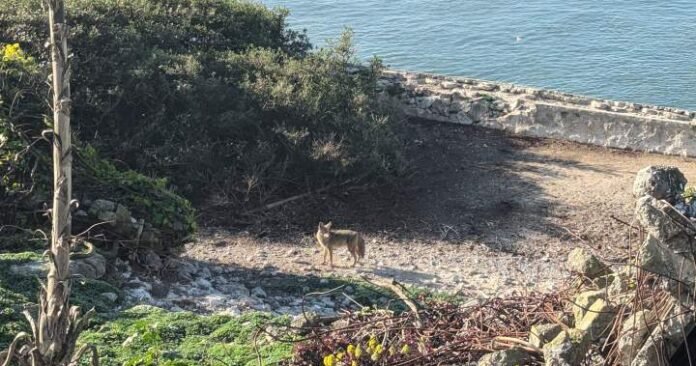


A lone coyote baffled biologists and others when it made a successful solo swim to Alcatraz Island earlier this year, the site of a former federal prison in San Francisco Bay encircled by treacherous waters that hampered many an escape attempt.
Now, experts have learned the animal travelled even farther than previously thought.
When it was first seen, biologists guessed the coyote swam from San Francisco proper, which is a little over 1.6 kilometres from the notorious jail. But it turns out the male coyote actually made an even longer swim from nearby Angel Island, 3.2 kilometres away from Alcatraz.

“Our working assumption was that the coyote made the swim from San Francisco because it is a significantly shorter distance,” National Park Service wildlife ecologist Bill Merkle said in a news release Monday.

Get breaking National news
Get breaking Canada news delivered to your inbox as it happens so you won’t miss a trending story.
“We couldn’t help being impressed by his accomplishment in making it to Alcatraz.”
Hailed by the park service for its “epic” swim, experts say the coyote displayed adaptability and resilience, two salient characteristics of the species, Merkle explained.
Soon after the animal was spotted on Alcatraz in late January, a co-ordinated effort was launched to learn more about the unlikely visitor.
Staff surveyed the island for tracks, installed trail cameras and audio recording devices, and collected samples for laboratory testing.
FILE – Alcatraz Island is seen in San Francisco, Oct. 10, 2025.
AP Photo/Jeff Chiu, File
Coyote droppings collected on the island were analyzed at nearby UC Davis. Results confirmed the coyote was a male and matched him to Angel Island’s coyote population.
Researchers were interested in locating the coyote because of Alcatraz’s role as a seabird nesting habitat, the park service statement says, and were prepared to safely capture and relocate the animal to a more suitable habitat in the vicinity.
Camilla Fox, founder and executive director of non-profit Project Coyote, said the animal likely left its home in search of a mate or new territory to defend. She said coyotes, like wolves, do swim, although it’s incredibly rare for humans to spot one treading water.
“We have never, ever heard such a story of a coyote making such a long journey in a pretty challenging ocean current,” she said.
Footage captured in early January showed the coyote paddling in San Francisco Bay and then clambering onto the rocky island.
It was followed by a Jan. 24 visitor sighting and photographs by Rebecca Husson, who was in town for a cousin’s wedding.
She and her family were surprised to spot the coyote on their morning tour of Alcatraz Island.
“He looked like a drowned rat when he ended up on the island, and when we saw him, he looked healthy and so beautiful. He looked like he had been eating well,” she told The Associated Press on Tuesday.
Alcatraz Island became a federal prison in the 1930s, designed to house the worst criminals, but it closed in the 1960s because its remoteness made it too costly to operate.
Still, 36 men attempted 14 separate escapes from Alcatraz. Nearly all were caught or didn’t survive the cold, powerful current. In 1973, the island reopened as a park and it is now open for tours.
— with files from The Associated Press
© 2026 Global News, a division of Corus Entertainment Inc.