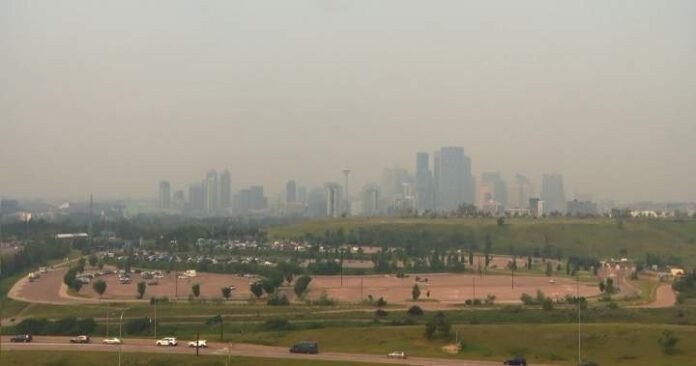


A thick blanket of wildfire smoke that hung over the City of Calgary Friday sent the city’s air quality index soaring — and compared to the air quality in other major cities around the world, it was among the worst on the planet, according to measurements by Switzerland-based air quality technology company IQAir.
Environment Canada’s Air Quality Health Index (AQHI), which measures a combination of common air pollutants that are harmful to human health, including ground-level ozone, nitrogen dioxide and particulate matter, put Calgary’s air quality at 10+, which is defined as “very high risk.”
The AQHI measures air quality on a scale of one to 10, with one being the best air quality and 10 being the worst.
In Edmonton, where the air quality index was in the very high risk range earlier in the week, the air quality had improved to a five, at around noon on Friday, which is defined as “moderate risk.”

Using the colour-coded and numerical scale of IQAir, Ashcroft, B.C., which is located in the Thompson River Valley, west of Kamloops, had the worst air quality in Canada.

Get weekly health news
Receive the latest medical news and health information delivered to you every Sunday.
Airdrie, Alta., had the third-worst air quality, followed closely by Calgary with the fourth-worst air quality. Banff was eighth and Canmore tenth.
But compared to other major cities listed, such as Lahore, Pakistan, Delhi, India and Beijing, China, the air in the top 10 Canadian communities, including Calgary, Banff and Canmore, was worse than any other city on earth.
Calgary’s Air Quality Health Index on Friday was listed as a 10+, putting it very high on the list of the cities with the worst quality air on earth.
Source: weather.gc.ca
The dangerous air quality prompted Environment Canada to issue “orange” air quality alerts for a large swath of western and central Alberta, stretching from Saskatchewan River Crossing, located along the Icefields Parkway, north of Lake Louise, south to Kananaskis Country and extending east to the Calgary area.
Under the national weather agency’s colour-coded alert system, an “orange” alert means there are expected to be significant health impacts that are widespread and may last for a few days.
“Poor air quality is harmful to us. It can cause asthma and COPD [chronic obstructive pulmonary disease] attacks,” said Dr. Anne Hicks, a pediatric respirologist at the University of Alberta, in Edmonton
“It increases your risk of being really sick with a respiratory infection … It can even increase the risk of stroke in people.”
Much of the rest of southern Alberta, along with southern Saskatchewan and Manitoba, were under a “yellow” air quality alert, which means the health impacts are expected to be more moderate, localized and short term.

Environment Canada said the smoke over southern and central Alberta “is expected to remain in the area” Friday and may even worsen as more smoke from fires in British Columbia is expected to pour in today.
However, the weather agency predicts, “some areas may see improvement on Saturday” ahead of a developing system that will push the smoke to the north.
© 2026 Global News, a division of Corus Entertainment Inc.