
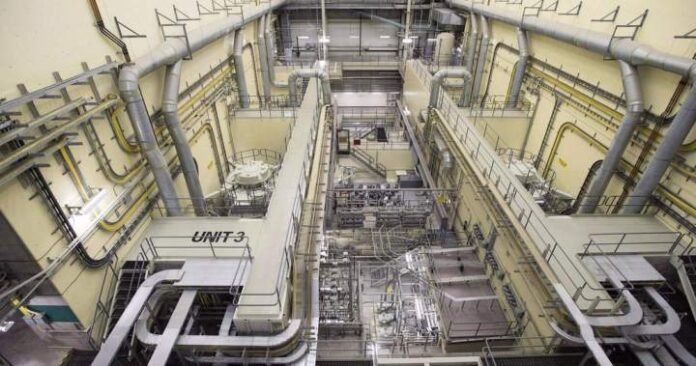


A group of B.C. First Nations recently travelled to Ontario to learn about nuclear power and small modular reactors and how they could help the province meet its growing electricity needs.
Ontario is moving ahead with plans to build up to four small modular reactors (SMRs).
The Respective Territories of the Haisla Nation, Metlakatla First Nation, Nisga’a Nation, Halfway River First Nation and Ts’il Kaz Koh First Nation are now asking if that technology could one day have a place in B.C.
“Is it the right thing?” Chief Wes Sam of the Ts’il Kaz Koh First Nation said.
“I don’t know, I’m trying to determine that. I’m not for or against, but I like to educate myself and so does my community, and maybe probably the province of B.C. should look into potential possibilities.”
B.C. is expecting a surge in electricity demand over the next two decades. While the province is betting on wind and solar, First Nations say they’re exploring every option to meet future energy needs.

Get breaking National news
Get breaking Canada news delivered to your inbox as it happens so you won’t miss a trending story.
“While infrastructure co-ownership is already a well-established model for our Nations across LNG plants, port infrastructure and gas facilities, introducing advanced nuclear power like small modular reactors represents a completely new frontier for British Columbia,” Sam added.
“As we lead major industrial decarbonization efforts across northern B.C., we must proactively evaluate every potential low- and zero-emission power option to sustain our economies and secure our clean energy future.”
For now, nuclear isn’t part of the B.C. government’s plans.
The B.C. government says nuclear power isn’t in its plans for now, saying recent power calls attracted thousands of megawatts of wind and solar proposals, much of it Indigenous-led.
There are also questions about whether SMRs make economic sense in B.C.
Ontario’s first reactor is still years from completion, and experts say building an industry from scratch in Western Canada would take even longer and cost even more.
“I think the evidence on that is pretty clear that renewables are lower cost than anything else right now, and … that wasn’t the case, you know, 15 years ago,” Tim Weis, senior director of the Industrial Decarbonization group at the Pembina Institute, said.
“But wind, solar, and batteries are the lowest-cost electricity we’ve ever seen from any technology, and so they’re basically outcompeting almost everything.”

First Nations leaders insist the trip wasn’t about endorsing nuclear power.
They say it was about understanding a technology that could become an option decades from now, while renewable energy remains the immediate focus.
© 2026 Global News, a division of Corus Entertainment Inc.