
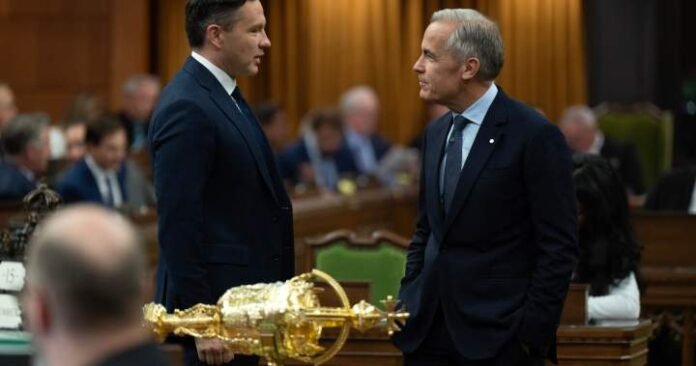


As MPs gathered in the House of Commons at 2 p.m. Monday for daily question period, Prime Minister Mark Carney was 20 minutes away, posing for a photo op in front of a housing development in his riding.
The Leader of the Official Opposition, Pierre Poilievre, had hoped the prime minister would be present in the House of Commons to answer questions about the economy, given that, on Friday, Statistics Canada noted that gross domestic product output shrank during the quarter ending March 31, the second consecutive quarter in which the economy contracted.
One definition of a recession is two consecutive quarters of negative growth. But with the second quarter shrinking by just 0.1 per cent, BMO Economics senior economist Robert Kavcic argued against applying that label. “There is much more to a recession than two quarters of negative GDP growth,” Kavcic wrote. “Things aren’t great, but Canada isn’t there yet.”
Still, whether the country is in a recession is a debatable point, and that’s precisely what Poilievre wanted to do: challenge the prime minister for leading the country into what Conservatives argue is a “full-blown” recession.
But in skipping QP for a photo op — where he took no questions — Carney continued a pattern now clearly established during his time as prime minister of avoiding accountability to members of Parliament.
“Question period, where normally prime ministers go to answer, especially in a moment of crisis when the economy has fallen into the only recession in the G7, you’d expect him to be there to be accountable, to show his incredible economic brilliance, but he’s not showing up for question period,” Poilievre told reporters Monday morning in the House of Commons foyer.
Monday’s question period was the 123rd such session in the current Parliament and Carney has been present for just 33 of those sessions, or 26.8 per cent.

Get breaking National news
Get breaking Canada news delivered to your inbox as it happens so you won’t miss a trending story.
By comparison, former prime minister Justin Trudeau was present for 51, or 41.5 per cent, of the first 123 question periods in his tenure, while Stephen Harper could hardly be kept away from QP, showing up 80 of his first 123 times, or 65 per cent.
“I answer questions all the time,” Carney said on April 22 when challenged about his question period attendance record. “We have a very strong team in this government. And I believe in the team of ministers, secretaries of state, parliamentary secretaries responding.”
Carney’s supporters say he’s too busy for QP, that he’s busy strengthening global trade networks on behalf of Canada with a formidable travel schedule. True, Carney has been out of the country for about 19 per cent of his time so far in office. But Harper, who had a war in Afghanistan to contend with, was out of the country about 15 per cent of his time in office at an equivalent point during his time as PM and still managed that 65 per cent attendance rate in QP.
Carney is also said to be bored by question period and especially loathes Poilievre’s QP strategy of asking the same question over and over and over again.
“I would maybe suggest that if the leader of the opposition took question period a little more seriously, as opposed to just being a factory for clips where he’s asking the same 10 questions over and over again, that perhaps it might elicit something different out of it,” said Liberal MP Ben Carr (Winnipeg South Centre).
Fine. But no rule says the prime minister must answer only questions put to him by the leader of the Official Opposition. Carney could, for example, just answer the first question put to him by the opposition leader and then pass off to a member of his cabinet if Poilievre chooses to simply repeat. Don’t like the question? Don’t answer.
And then, to reinforce the point that boring, repetitive questions will be ignored, the PM should look for the first opportunity to answer a question posed to the government in an intelligent and interesting way — even if that question comes from a backbencher. Poilievre and other MPs would then soon get the hint that the prime minister’s engagement can be earned by a parliamentarian who chooses to elevate the tone of debate in the House.
Carney’s odd personal restriction is that he will only stand to answer a question from the leader of a recognized party (or a proxy) in what is informally known as the “leader’s round” in QP. There’s no rule that says prime ministers must only answer to other leaders. Carney should cease restricting himself to the leaders’ round.
That practice has meant that, in the course of those 123 QPs to date, Carney has yet to respond to a question from a single New Democrat because the NDP, with just five MPs, is not an officially recognized party. And yet, Carney himself broke his own self-imposed prohibition when he answered a question from the lone Green Party MP, Elizabeth May, on the day when his government needed her vote to survive a confidence motion.
Trudeau, it should be noted, established the habit for the last years of his premiership of taking all of the questions, regardless of who raised them, every Wednesday.
So if Carney — and his supporters — believe he is justified in staying away from question period because of the banality of the questions, there is an obvious and easy solution for the prime minister: Do away with his self-imposed guidelines that govern who he does and does not deal with in QP and seek out chances to answer more interesting questions.
But there can be no excuse for Carney’s rate of delinquency in the House. Showing up once a week to take just a handful of questions shows a disrespect for the institution and for all members of Parliament. The House of Commons is the venue in Canada’s system where the executive is accountable to the legislature.
A prime minister who puts so little value in participating in the House of Commons weakens the institution and, in making that institution less vital, weakens Canadian democracy.
David Akin is the chief political correspondent for Global News and has been covering question periods since 2005.