
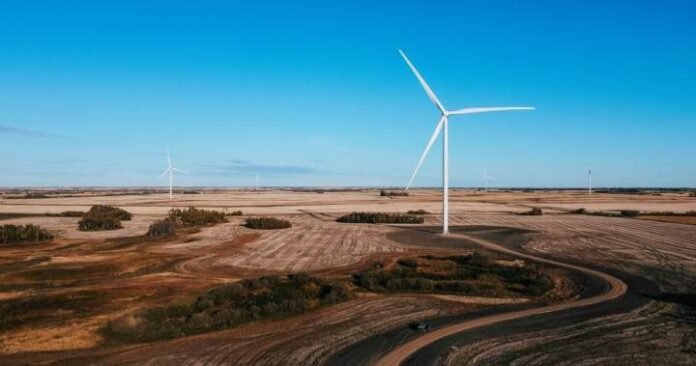


Don Bourassa says a proposed wind farm near his home in southeast Saskatchewan has ruined relationships in his community — to the point where he feels he has been bullied.
A resident of the Rural Municipality of Weyburn, Bourassa said one of his neighbours approached him about buying his property to keep him quiet on Enbridge’s Seven Stars Energy Project.
“He wants me out of there, to shut up,” Bourassa said in an interview. “That’s bullying and I’m not falling for that.
“It’s neighbours hating each other.”
Enbridge is planning to build the 200-megawatt facility near Weyburn, Sask., southeast of Regina, by late 2027. It would be one of the province’s largest wind facilities, featuring 46 turbines capable of powering about 100,000 homes.
It’s also eight kilometres from Bourassa’s acreage.
He said lines have been drawn between those who are getting money from the project and those who aren’t. If it goes ahead, the wind farm would occupy some private property.
“We didn’t buy these acreages to have these monsters come beside us,” he said. “I didn’t live here for 35 years to have a project like that dumped on us.”
Residents have recently packed town halls in the municipality, urging elected officials not to approve it. They argue it will harm their livelihoods and the surrounding environment.
Kim Brady, another resident, said the project has pitted neighbours and relatives against one another.
“People don’t talk, they won’t talk. It’s not ever going to go away,” he said. “I hope (the province) sees how unhappy residents are and, hopefully, they are going to listen and stop this project.”
Half of the turbines are to be located in the Rural Municipality of Weyburn, while the other half are to be in the Rural Municipality of Griffin. Weyburn has approved the project’s development permit, but Griffin has not.
Related Videos

Griffin has said it needs to receive documents on the project’s environmental effects before it makes a decision.

Get breaking National news
Get breaking Canada news delivered to your inbox as it happens so you won’t miss a trending story.
Both municipalities declined interview requests on the project.
Enbridge said in a statement it’s continuing to address Griffin’s questions. It has also filed its environmental impact statement, the company said.
Bourassa said there’s concern the turbines will be noisy, affect wildlife, become an eyesore and bring down property values. He also argues they’re not as environmentally friendly as advertised, as they’d require loads of raw material in order to be built.
He said he also worries the oil used to lubricate the turbines’ moving parts could leak into groundwater. “I don’t want to take that chance,” Bourassa said.
Brady said he’s concerned about the light the turbines will emit at night when planes fly over. “These things are heavily subsidized … which is taxpayers’ money,” he said.
The province is providing a $100-million loan guarantee to the project through the Saskatchewan Indigenous Investment Finance Corporation. Six First Nations communities and Métis Nation-Saskatchewan are to receive the loan to acquire 30 per cent equity in the project.
Saskatchewan’s government says it supports the farm.
“(It) will increase Indigenous participation in the economy, create jobs and add generation capacity to our power grid,” it said in a statement.
The City of Weyburn, which is surrounded by the Rural Municipality of Weyburn, also supports it.
Mayor Jeff Richards said the project could be transformative.
“The overwhelming majority of residents that I’ve spoken with are in favour of the project,” he said. “They’re excited to see the investment in our area.”
Enbridge said the project will bring in $4 million each year to the Weyburn area for 30 years. This includes tax revenues for rural municipalities, road upgrades and lease payments to landowners.
The company said lubricants for generators would be contained in oil-tight platforms. It also said no turbines would be built within permanent or semi-permanent wetlands or waterways.
About 40 landowners are to receive payments from the project, but the compensation terms are confidential, the company said.
In responding to residents’ concerns, Enbridge said it plans to move turbines further away from homes. It’s also to install lights that only turn on at night when aircraft are nearby. Noise levels also wouldn’t exceed 40 decibels, or that of a “quiet library,” it added.
“As for property value, please note that based on the current body of literature, our view is wind projects do not have a measurable negative effect on rural property prices,” Enbridge said.
Saskatchewan has recently seen two other large wind farms built over the past four years.
A 200-megawatt Bekevar Wind Facility near Kipling, southeast of Regina, began operating two years ago. Southwest of Regina is a 200-megawatt farm built in 2022.
James Husband, reeve of the Rural Municipality of Hazelwood, where the Bekevar project operates, said public opinion on the facility has been divisive.
“My opinion is all of the arguments against them are mostly just excuses for the fact that people don’t like them politically,” he said. “As far as the energy being renewable and clean energy, I think that’s irrelevant.”
He said council chose to support the project because it would bring in large tax revenues.
The facility is to provide $300,000 this year and about $600,000 in two years once the municipality starts collecting 100 per cent of the share, he said.
The money will go toward better roads and improving recreation facilities, Husband added.
“With these turbines comes federal money. Any way we can get the federal government to spend money in Saskatchewan is a positive,” he said.
The Canada Infrastructure Bank, a federal Crown corporation, spent $173 million on the facility and Ottawa has invested $50 million.
As for light and noise issues, Husband said it’s minimal.
“When I go out to check cows in the middle of the night, I’ll see all the red lights blinking. I don’t think that’s a big deal,” he said. “If you stand right underneath them, there’s a bit of noise, but not any more than the wind on a windy day.”
He added, “Birds aren’t dying.”
Patricia Jackson, mayor of Kipling, said the facility hasn’t changed the way her community lives.
“Truthfully, I think what’s happened is we’ve got two sides that have become polarized,” she said. “Nobody is prepared to sit down and listen.”
This report by The Canadian Press was first published March 28, 2026.