

A visit to his Instagram and you will see Trennon Paynter jumping off a mountain on a hang-glider, taking a corner on a motorcycle, foil-boarding, catching a wave, carving through fresh powder on skis or snowboarding high above a halfpipe.
Not to mention hurling himself off a cliff attached to a long static line, the other end of which was attached to the middle of a slack line that bridged a chasm.
Paynter called the one-off a “giant swing.” Others might call it insanity.
“It was a safe thing,” Paynter said. “But it was very exciting.”
No wonder Paynter was named in 2012 to ESPN’s list of the “50 most influential people in action sports.”
The 56-year-old Canadian halfpipe ski coach has not slowed down since.
Hang-gliding is a favourite pastime.
“To me it’s the closest thing to being a bird,” said Paynter, who also has his pilot’s license and flies small planes.
“It’s not as scary or dangerous as people’s perception of it is,” he added. “It’s another form of aviation … The safety or danger in it really lies in the decisions you make.”
But others can see it differently.
“I know my mum has held her breath more than a few times,” said Paynter. “But she’s also been really supportive of it. I’ve been lucky. Both my parents have been so adventurous.”
Adventurous enough to move to Australia, where Paynter was born. The family moved back to Canada when he was five, and he grew up in Kimberley, B.C., but now calls Squamish home.
He started ski racing before turning to freestyle skiing in his late teenage years. During the ’90s, he competed in moguls on the world scene and placed ninth representing Canada at the 1999 World Championships in Meiringen, Switzerland.
Related Videos

Paynter was sidelined in 2000 when he broke his pelvis in World Cup competition at Deer Valley. Paynter recovered and represented Australia at the 2002 Olympics in Salt Lake City, finishing 23rd.

Get breaking National news
For news impacting Canada and around the world, sign up for breaking news alerts delivered directly to you when they happen.
“A dream come true,” he recalled.
“The experience was varied,” he added. “I was not thrilled with my result. I certainly felt I was capable of better in terms of the result I got there. But given my situation leading up to it — the injury, the comeback, the challenges — and just the sort of lifelong dream of skiing in the Olympics, it still was overwhelmingly positive.
“The moment of standing in that start gate, looking out — they had a big stadium erected for fans — and just that knowledge that you’re on the world’s greatest sporting stage, it is something that has stuck with me for life.”
It’s a feeling he works hard to help his athletes achieve.
“He’s done so much for the halfpipe team … He’s always thinking outside the box,” said close friend and former Olympic snowboard champion Maelle Ricker, who is co-head coach of the Canadian snowboard cross team. “And he always puts the athletes first in everything. We’re very lucky to have him as part of the Canadian Olympic sports system, for sure.”
Paynter retired after the 2002 season but came back in 2004, while coaching the Alberta ski team, to compete in a World Cup event in Fernie, B.C. Flips were finally allowed in moguls competition, so “I finally got to go upside down in a moguls competition.”
“But more importantly, I got to compete very close to home at a resort where I had spent so much of my time as a kid, and so many friends and family drove up from Kimberley to watch. So that was special.”
In all, he made 53 World Cup starts, with eight top-10 finishes, including a career-high fifth in Blackcomb in 1999.


Paynter was among the group led by the late Sarah Burke that successfully pushed for halfpipe skiing to be added to the Olympic program (snowboard halfpipe had been in since 1998).
“We saw what snowboarders were doing. We said that it looks like fun. We started jumping into the ‘pipe with them,” said Paynter. “The Olympics, however, it’s a slow-moving animal.”
Burke and Paynter were close friends, and he coached her at the 2005 FIS Freestyle World Championship, where she won the inaugural halfpipe ski event. Tragically, Burke died in 2012 after a training accident and never got to see her sport debut at the Sochi Olympics in 2014.
Halfpipe skiing has evolved ever since, with the bar constantly being raised.
“Ridiculously,” Paynter said with a chuckle. “The comment that gets tossed around, it seems, forever is ‘Well, I can’t see it getting any crazier than this.’ And then somehow it does.”
“It used to be an eight-foot high 540 was kind of a game-changer trick. That was world-leading. And now we have people doing 23-foot-high double-cork 1620s,” he added. “The scale of it, the amplitude, the rotations — of course, this is supported as well by how much better the halfpipes have gotten.”
As that level has risen, so has the danger and the requirements for the halfpipe to be perfect. Paynter says that has made it harder — and more expensive — for resorts to build the kind of halfpipe that top athletes need to train on.
“And so a lot of resorts, unfortunately for us, have just moved on,” he said.
Calgary has the only halfpipe that meets the Canadian team standards for training on home soil.
“I’d love to see that change,” said Paynter.
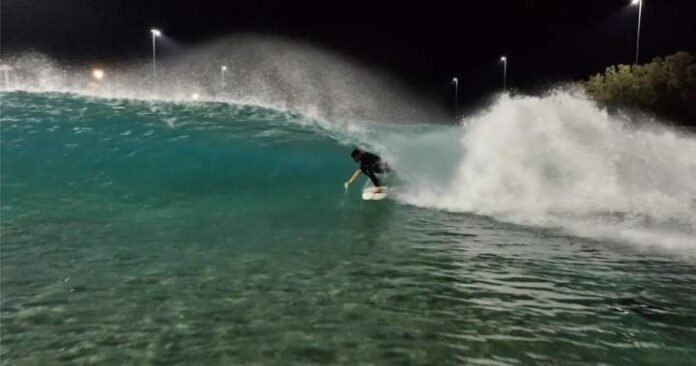
He got into surfing in his late ’30s and has started working with elite surfers, who are starting to do the kind of aerial rotations Paynter is so familiar with.
“A wave is a lot like a halfpipe,” he explained.
It’s another sport that provides swoopies, a word Paynter conjured up to describe the sensation of simultaneous side-to-side and up-and-down movement.
Paynter has also raced motorcycles, a love he got from his father. He has several motorcycles, including an Indian FTR 1200 — “very fast, very fun” — as well as a KTM 530 EXC dirt bike and a couple of older models.
When it comes to four wheels, he drives a 1994 Ford Ranger that is eggplant purple.
“My vehicle budget went into motorcycles,” said Paynter, who has been the head coach of the Canadian halfpipe ski team since May 2011.
—
This report by The Canadian Press was first published Feb. 9, 2026.