
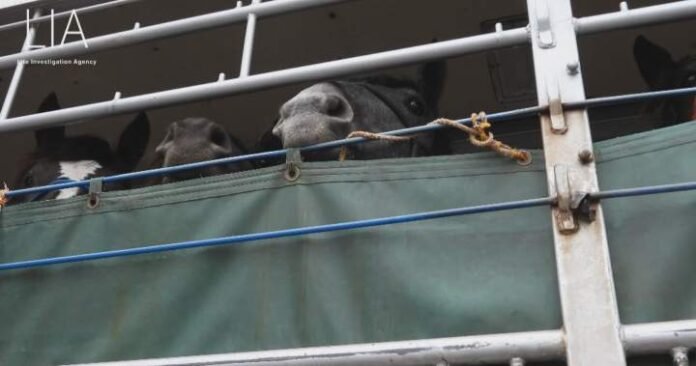


Horses flown from Canada to Japan for slaughter continue to get sick, get injured and even die, according to a new investigation by animal rights advocates.
The report, compiled by Animal Justice in partnership with the Japan-based Life Investigation Agency (LIA), used data from documents provided by the LIA and Canadian Horse Defence Coalition.
It examines data from 2024-25 that it says comes from the government of Japan, obtained through access to information requests.
Global News has not independently verified the data, but has contacted Japan’s Ministry of Agriculture, Forestry and Fisheries.
The report includes records from 18 shipments of horses from Edmonton and Winnipeg to Japan, with approximately 1,822 horses on board in total.
From September 2024 to September 2025, the data showed at least nine horses died as a result of transportation to Japan for slaughter.
“I wish I could say I was surprised, but I wasn’t; we’ve seen this before,” said Kaitlyn Mitchell, director of legal advocacy for Animal Justice. “Nobody is looking out for these horses.”
Horses are exported by cargo jet from Canada to Japan annually, where they’re slaughtered for human consumption, according to the Winnipeg Humane Society.
Yet the report notes none of these deaths are found in the Canadian Food Inspection Agency’s records.
The CFIA’s website shows that between July 2024 and June 2025, there were zero deaths and zero injuries among horses shipped to Japan.

According to the report, more than 290 horses were injured or suffered illnesses after arriving in Japan. Among the cases, horses had high fevers, bleeding lacerations or severe leg injuries, and some had missing hooves or parts of ears.
Animal Justice says at least five shipments also appeared to exceed Canada’s 28-hour legal limit for transporting horses without food, water or rest.

Get breaking National news
Get breaking Canada news delivered to your inbox as it happens so you won’t miss a trending story.
It’s why animal rights groups are urging Canada to renew plans to ban the exporting of horses by air.
Such a promise was made in the Liberal party’s 2023 election campaign, and in the same year, a private member’s bill was put forward by Liberal MP Tim Louis.
Bill C-355 was passed by the House of Commons in May 2024, but it stalled in the Senate and when former prime minister Justin Trudeau prorogued Parliament in January 2025, the bill died.
A new bill has not been presented, but Mitchell says she’s urging the federal government to act.
“What we’re really asking for now is just a ban that could be passed by pretty straightforward regulatory amendments,” Mitchell said.
“All we really want the government to do is introduce really straightforward, targeted regulations that would ban this practice immediately.”
Exporters’ association responds
The Canadian Equine Exporters Association (CEEA), which speaks for the equine export sector in Canada, said in a statement that it has reviewed a copy of the report and that “any and all allegations of suffering to CEEA horses is taken with incredible sincerity and concern.”
The association goes on to say the allegations are “alarming” and its officials are studying the report to independently verify them.
The CEEA goes on to say the industry is heavily regulated and that it works closely with the CFIA and other regulatory boards to ensure animal welfare is maintained.
“Animal Justice is an activist group with a long history of advocating against the practice of animal agriculture in Canada and using extreme tactics to advocate for their position,” the CEEA added.
“CEEA will work diligently and swiftly to analyze records and official reports of all shipments outlined in Animal Justice’s September 2024 report and present the unbiased facts to government decision makers and the public once compiled.”
The industry itself is primarily based in Alberta, but there are also companies and producers in Manitoba and Ontario.
Asked about these exports from the province, a spokesperson for Alberta Agriculture Minister PJ Sigurdson told Global News the federal government and the Canadian Food Inspection agency are the leads on the issue.
Callum Reid, the press secretary for Sijurdson, said Alberta believes animals should be always treated humanely.
“Animal welfare and processing requirements for horses are consistent with other livestock in Alberta,” Reid said. “This includes working with the CFIA and other relevant certification bodies to ensure the province meets national and international standards for animal welfare and food safety.”
© 2026 Global News, a division of Corus Entertainment Inc.