
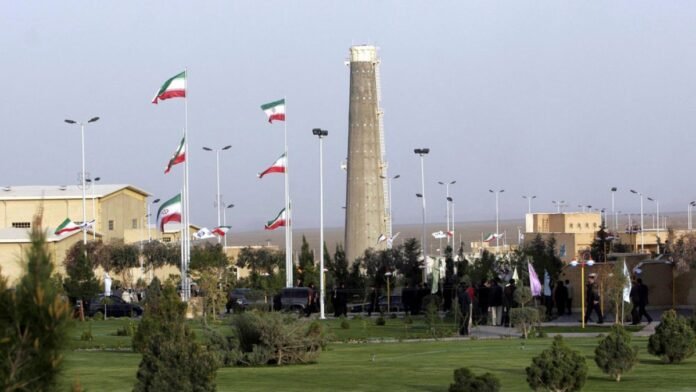


Tehran, Iran – Iranian politicians are pushing to exit the country from the Treaty on the Non-Proliferation of Nuclear Weapons (NPT) as the United States and Israel ramp up their attacks to hit civilian nuclear sites, steel factories and a university.
It would be meaningless for Iran to remain a signatory to the international treaty as it “has had no benefit for us”, said Ebrahim Rezaei, spokesman for the national security commission of parliament, in a Friday night post on X.
Recommended Stories
list of 3 itemsend of list
Malek Shariati, a representative from Tehran, said that a priority piece of legislation has been uploaded in an online parliamentary portal and will be reviewed soon.
Politicians have not held any sessions since the start of the war on February 28.
According to Shariati, the legislation will withdraw Iran from the NPT, revoke a law that adopted nuclear restrictions linked with a now-defunct 2015 nuclear deal with world powers, and “support a new international treaty with aligned countries [including Shanghai Cooperation Organization/BRICS] on developing peaceful nuclear technologies”.
Hardliners have previously demanded an NPT exit and a nuclear bomb in response to outside pressure.
If such a law is approved by the parliament, it would also have to be agreed by the Guardian Council – a powerful 12-member constitutional body, before being implemented by the government.
Iranian authorities continue to accuse the International Atomic Energy Agency (IAEA) of taking a politicised stance and being complicit in attacks against Iranian nuclear sites, charges the United Nations nuclear watchdog rejects.
Mohammad Mohkber, a senior adviser to the late Supreme Leader Ayatollah Ali Khamenei and a former first vice president under late President Ebrahim Raisi, said on Saturday that IAEA Director Rafael Grossi is a “partner in crime” in blood spilled during the current war and the 12-day war last June.
“His political reports about Iran’s peaceful nuclear activities, lack of condemnation for aggression against our nuclear facilities, and now encouraging the enemies to attack Iran’s nuclear sites, will bring the country to irrevocable decisions,” he warned, without elaborating.
Grossi told US broadcaster CBS News in an interview earlier this month that no war has the capability to totally destroy Iran’s nuclear programme, “unless it was nuclear war and you go for destruction unfathomable, which we hope will never be the case”.
Fada-Hossein Maleki, a member of the national security commission of Iran’s parliament, said on Saturday he believes that Grossi has acted as an “agitator” for months in order to please US President Donald Trump. He said the nuclear bomb comment “violates all international norms and constitutes a provocative act”.
Electricity, steel become targets
Israeli and US forces significantly intensified their attacks on Friday, in some cases destroying infrastructure that will have long-term repercussions for Iranians and the country’s beleaguered economy that is struggling with an energy crisis and inflation rates of about 70 percent.
Warplanes bombed a yellowcake facility in Yazd and the Khondab Heavy Water Complex near Arak, and so far, at least three projectiles have landed in the vicinity of the Bushehr Nuclear Power Plant, prompting IAEA warnings about the potential for a major radiological incident.
Heavy air strikes also pummelled Iran’s steel giants, namely the Mobarakeh complex in central Isfahan, and the Khuzestan complex in western Ahvaz. Production lines and power plants feeding them were targeted, prompting the Ahvaz complex to announce suspension of production until further notice on Saturday.
The companies form the backbone of Iran’s non-oil exports, and were projected to rack up billions of dollars in revenue at a time when Washington is also trying to choke off Iran’s oil exports. Thousands of jobs may be at stake after major damage to the sites.
The bombing came after Trump twice announced delays on launching destructive attacks against Iran’s power plants, which he said would last until April 6. He has also claimed that negotiations with Iran “are going very well” as the two sides present conflicting positions.
Tehran has undergone two of its most intense nights of bombing, with overnight strikes into Saturday lighting up the night sky orange and also leading to temporary power outages across multiple areas. Some citizens reported smelling strong odours left from the detonation of the powerful explosives in the morning in some areas.
But almost the entirety of Iran’s population of at least 90 million has been unable for one month to freely communicate its experience with the international community since the Islamic republic has completely blocked internet connectivity. Only an intranet is operational to offer some basic services and limit the flow of information to state-run outlets.
The internet was totally cut off for 20 days in January, when thousands of protesters were killed during nationwide demonstrations that the government blamed on “terrorists” backed by the US and Israel. The streets of Tehran and many cities across Iran are now filled with armed state forces who have strictly warned against further protests.
State media outlets also continue to release videos of “confessions” from Iranians, including one on Saturday showing a crying girl with a blurred-out face, who said she was apprehended after filming missile strikes from the window of her family home and sending the footage to foreign-based media.
According to videos circulating online and state media reports, one of the strikes that targeted the Iranian capital overnight was directed at the Iran University of Science and Technology.
Some reports said a centre carrying out satellite-related research activities was bombed, but the university only said “research and educational buildings” were attacked, which also disturbed civilians in nearby residential areas and a hospital, but inflicted no casualties.
More major air strikes have been reported over the past day in Karaj and Shahr-e Rey near Tehran, as well as in Yazd, Shiraz, Tabriz, Bushehr and a number of other cities.