

Markets are embracing the idea that we are in an AI supercycle. Investors are betting on a multi-decade technological shift, similar to the internet, that will transform industries, computing, and infrastructure. And similar to the internet buildout, a massive capex cycle accompanies AI. According to Bloomberg estimates, hyperscalers like Alphabet, Microsoft, Amazon (via Amazon Web Services), and Meta are expected to spend over $600 billion in aggregate this year on the AI buildout.
Key Takeaways:
- Q2 2026 performance was dominated by AI and perceived AI bottleneck trades.
- AI server demand fueled rallies in Semiconductor, AI-Related, and South Korean ETFs.
- The biggest individual ETF winner, exposed to all three of these themes, was Roundhill’s DRAM, which surged to over $20 billion in assets under management.
- The space economy was another big theme for the quarter, driven by interest in the SpaceX IPO.
Another driver behind the AI supercycle is the shift from clunky chatbots to agentic AI. Agentic AI takes productivity to the next level, autonomously facilitating things like travel, communication, and daily tasks without the need for human intervention. Similar to the age of the internet, all of this AI “firepower” is becoming decentralized and available on our computers, laptops, and mobile devices, accessible to the masses.
Are we in a bullish decade-long transformation or a bearish short-term speculative bubble? Hyperscalers are heavily investing in the AI supercycle, and ETF investors in the second quarter were, too.
AI-Related Booms
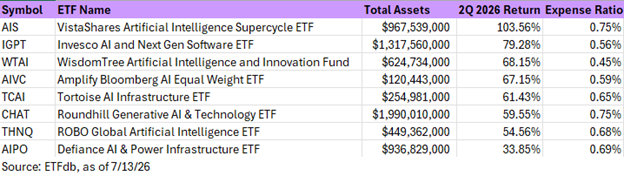
Artificial intelligence was the theme that drove the quarter, so it stands to reason that AI ETFs as a thematic category outperformed as well. Atop the AI leaderboard was the VistaShares Artificial Intelligence Supercycle ETF (AIS), an actively managed ETF, which gained 103.6% holding a global basket of AI-related names, focusing heavily on infrastructure and semiconductor exposure. Another top ETF in the category, the Invesco AI and Next Gen Software ETF (IGPT), also delivered strong returns at the intersection of AI and semiconductors, with 52% of the ETF’s 102 holdings exposed to semiconductors and equipment.
There are a lot of ETFs with AI in their names these days, but the exposures can be very different under the hood. They range from AI applications and software, to hardware and semiconductors, to the underlying infrastructure.
Chip ETFs Were Big Winners
The big ETF winner for the quarter, actually making ETF success history, was the Roundhill Memory ETF (DRAM). The ETF offers global exposure to a narrow portfolio of stocks, representing leading memory producers likely to benefit from AI-related demand. DRAM has delivered returns since its inception on April 2, 2026 of 161.5% (as of June 30, 2026) and has now amassed almost $23 billion in assets.
Why was this ETF so successful, ranking it as the most successful thematic ETF launch in ETF history?
- Most importantly, perhaps, was its first-to-market status as a product focused on a hot theme. That theme, memory, is a bottleneck for AI, with demand far outstripping supply.
- Secondly, it provided convenient access to several non-U.S. companies that are leaders in the theme, such as South Korean chipmakers Samsung and SK Hynix, which were not available as ADRs. Note that SK Hynix just debuted as an ADR on the Nasdaq. At $26.5 billion, it was the largest listing recorded for a foreign company, according to Bloomberg.
- Finally, other successful thematic ETFs in Roundhill’s lineup have similar investor appeal. They include the $4 billion Roundhill Magnificent Seven ETF (MAGS) and the $1.9 billion Roundhill Generative AI & Technology ETF (CHAT).
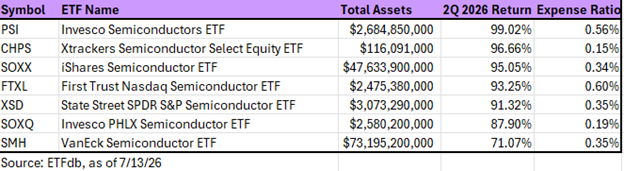
But DRAM was not the only chip ETF to gain assets and outperform in the second quarter. Below is a roundup of other semiconductor ETFs delivering strong returns and garnering investor attention.
South Korea Gains on Chips and Technology
The South Korean equity market has deep ties to the global semiconductor industry. Because chip giants like Samsung and SK Hynix make up a large portion of the country’s indices, almost 50% in aggregate, they are highly correlated to technologies like AI.
There are two ETFs that provide broad market exposure to South Korea: the Franklin FTSE South Korea ETF (FLKR) and the iShares MSCI South Korea ETF (EWY). Both ETFs delivered high returns in the second quarter, mainly due to their high technology and semiconductor allocations. Both ETFs have more than 20% of their portfolios allocated to technology hardware and semiconductors. FLKR gained 66.51% in Q2, and EWY was up 64.13%.
SpaceX IPO Launches Space
You cannot talk about second-quarter thematics without talking about space. Space economy ETFs rallied in the second quarter, amid the excitement created for the theme by the SpaceX IPO on June 12. The event also caused many indexes which underly funds to include SpaceX on a fast-track IPO basis. Those include the NASDAQ 100 Index and our very own VettaFi Space Index.
The category added several new ETF entrants during the quarter, from issuers such as Global X, VanEck, and Wisdom Tree. Among the ETFs with a full quarter of performance, however, the Tema Space Innovators ETF (NASA) was the performance winner. According to the issuer, it was the only ETF that held SpaceX in pre-IPO form as a special purpose vehicle (SPV), and the fund gained 20.68% for the quarter. It was followed by the actively managed ARK Space & Defense Innovation ETF (ARKX), up 16.25% and the Procure Space ETF (UFO), up 13.21%.
While this category saw a lot of asset flows ahead of the IPO, some of those assets ended up being placeholders for IPO shares. Large outflows totaled $500 million, as tracked by State Street Research. While NASA sits at $1.3 billion in assets, ARKX with $826 million, and UFO with $666 million, all are off their peak asset levels.
Thematics Having Banner Year
As demonstrated by the massive success of the DRAM ETF, thematic ETFs are more popular than ever, offering investors targeted access to long-term growth themes such as AI, robotics, memory, and infrastructure. Thematic ETFs have far surpassed the momentum seen in 2025. After the category gathered $23 billion in assets last year, just a single thematic ETF (DRAM) gained roughly the same amount in the first half of 2026.
U.S.-listed ETFs have absorbed $1 trillion already this year, on pace to break last year’s record $1.5 trillion haul (according to Bloomberg Intelligence). To quote VettaFi’s Head of Sector and Industry Research, Roxanna Islam, “Every year, more investors are appreciating the benefits of the ETF wrapper. And it’s not just for existing strategies, but there’s increasingly newer and innovative strategies that are being placed into the ETF wrapper that are attracting attention.”
Thematic ETFs remain a clear example of ETF innovation, with tailored exposure matching investor demand.
For more news, information, and analysis visit the Thematic Investing Content Hub.
VettaFi LLC (“VettaFi”) is the index provider for THNQ and UFO for which it receives an index licensing fee. However, THNQ and UFO are not issued, sponsored, endorsed or sold by VettaFi, and VettaFi has no obligation or liability in connection with the issuance, administration, marketing, or trading of THNQ or UFO.
