
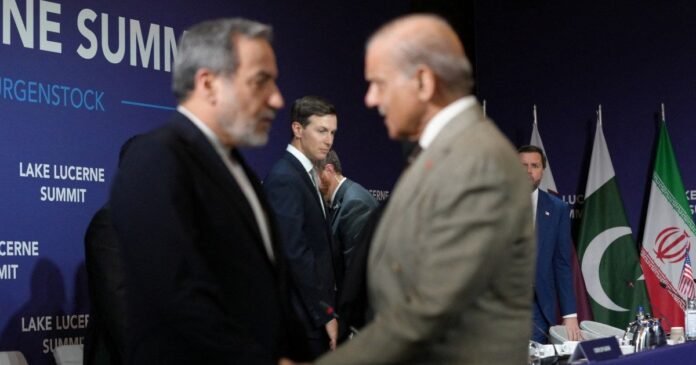


The United States says it has come up with a spending plan for unfrozen Iranian assets, as negotiations to reach a final deal to end the war in the Middle East continue.
President Donald Trump’s administration insists that the unfrozen money will be used to buy US agricultural products, which will then be provided to Iran.
Recommended Stories
list of 4 itemsend of list
Ultimately, that could translate into a $12 billion shot in the arm for the currently heavily restricted bilateral trade between the US and Iran, which is largely confined to humanitarian goods.
From being close trading partners to arch rivals over the past five decades, the US-Iran relationship has all but petered out.
However outlandish the idea may seem, can Trump restore trade ties with Tehran?
What is happening to Iran’s frozen assets?
As is the case with many things in the US-Iran negotiations, the two sides do not appear fully aligned on what has been agreed so far.
After the first round of talks in Switzerland on Monday, following the signing of the US-Iran memorandum of understanding (MoU) last week, Iran’s top negotiator, Mohammed Bagher Ghalibaf, said an agreement had been reached to release $12bn in frozen Iranian funds.
But US Vice President JD Vance said if Iranian assets are unfrozen, they will be used by Iran to buy US agricultural products. “They’re going to go to make American farmers richer and feed the Iranian people,” he said.
President Trump added: “We’re doing very well in terms of negotiating a fair and reasonable deal. … corn, soybeans, all of the things they need are going to be bought from our farmers. So our farmers are very happy. I’ve had a lot of calls; they were very happy about this.”
Next day, Trump posted on Truth Social: “The Money and/or Sanctions that the U.S. Treasury is releasing goes into escrow, controlled by the U.S.A., and will be used for the purchase of food and medical supplies, exclusively from the United States, including Corn, Wheat, and Soybeans from our great American Farmers. These are things that are desperately needed by Iran.”
“This is a humanitarian crisis, and I feel it is necessary to help, NOW, before it is too late. Talks are going well!”
Iran has not confirmed that it has agreed to this at all, however.
Iranian Foreign Ministry spokesman Esmaeil Baghaei said the assets “will be released and will be employed with absolute liberty by Iran in order to purchase whatever goods or commodities needed by the nation”.
He added that any agricultural purchases would be based on “prices and quality’’, not terms “dictated by Washington”.
“It is interesting that the philosophy and goal of the war, which was the destruction of the Iranian civilisation and the collapse of Iran, has become enriching American farmers,” Baghaei said.
Iran’s ambassador in Geneva, Ali Bahreini, also rejected the US contention, saying “Iran is the only country that decides what to do with those assets”.

How will this be agreed?
Gary Hufbauer, a non-resident senior fellow at the Peterson Institute for International Economics, said: “Any attempt to put spending conditions on unfrozen Iranian assets will lead to lengthy negotiations.”
In reality, he told Al Jazeera, “lots of Congressmen oppose the Iran deal, and multinational companies will be wary of another political flare-up and credit risk in doing business with Iran”.
Mohammad Reza Farzanegan, a professor and economist at Germany’s Philipps-Universitat Marburg, said the US president has a strong motive to force Iran to buy US goods: “To extract something positive for his reputation in this illegal war against Iran”.
Farmers in the US, especially soybean exporters, have been hurt by Trump’s trade war with China, the economist said. “Redirecting Iranian frozen assets towards US agricultural purchases would allow Washington to frame sanctions relief as humanitarian trade. But in reality, it is a move to improve his popularity among his social support base in the US,” he said.
Cullen Hendrix, a senior fellow at the Peterson Institute for International Economics, a Washington-based think tank, said the US proposal could also be a way of “avoiding the straightforward transfer of funds to Iran, which would scan as a capitulation by the US”.
Do the US and Iran trade at all?
Yes. Despite sour relations and decades of sanctions, Washington and Tehran maintain a small but persistent trade relationship with a trade surplus heavily in the US’s favour.
Direct trade remains tiny by international standards because broad US sanctions restrict most commercial activity. Most of what is traded is concentrated in humanitarian and sanction-exempted sectors such as medicines, medical equipment and agricultural products.
According to the US government, total US-Iran goods and services trade totalled $838m in 2024, a three percent increase from 2023.
Of that, the vast majority – $742m was in the form of services – of which nearly $600m was trade flowing from the US to Iran. Of the goods traded – almost all were American items being exported to Iran.

Could a peace deal revive US-Iran trade ties?
Re-establishing a broad trading relationship would be a stretch, analysts told Al Jazeera, as neither Washington nor Tehran appears willing to try to sell such an arrangement at home.
However, there are some areas in which the two sides could potentially meet in the middle.
Hendrix told Al Jazeera that if Tehran “were to begin large purchases of agricultural products, they would likely target corn and soy, but not in a way that would durably shift Iran to greater dependence on US exports”.
Since the kinetic part of the war is not completely over – both sides have said they are ready to resume all-out war if talks fail – even “the US’s own allies are trepidatious about putting all their eggs in the US basket. As an adversary, the logic of minimising reliance on the US is even more compelling”, Hendrix said.
Even if Tehran is forced to make some purchases of American goods, he added, Iran “is not going to hardwire dependence on US exports into its food system. The US should expect, at best, superficial, tactical compliance rather than becoming a pillar of Iranian food security”.
Farzanegan told Al Jazeera that the realistic trading options between the US and Iran are limited: food, agricultural commodities, medicine, medical devices and some related chemical or health-sector products.
“Agricultural trade could include wheat, corn, soybeans or soymeal, rice and animal feed, especially given Iran’s import needs,” he said, adding that the UN’s Food and Agriculture Organization expects Iran to need to import around 22 million tonnes of cereals this year – which would already amount to a multi-billion dollar bill.
Tehran could possibly export crude and refined petroleum products at competitive prices to the US, Hufbauer said.
What is the history of US-Iran trade?
Before the 1979 Islamic Revolution, Tehran was one of Washington’s closest allies in the Middle East, with trade expanding rapidly from the 1950s to the late 70s.
In 1953, the US helped re-install Shah Mohammad Reza Pahlavi to power through the overthrow of the democratically-elected Prime Minister Mohammad Mosaddegh who wanted to nationalise the oil industry.
The Washington-Pahlavi trading relationship was driven by exports of Iranian oil to the US, while the US sold aircraft, advanced military equipment, industrial machinery, automobiles, agricultural products and technology to Iran.
American firms such as Boeing, General Electric and Bell Textron had significant business interests in Iran until 1979 when Ruhollah Khomeini overthrew the Shah dynasty in the Islamic Revolution.
During a 444-day hostage crisis at the US embassy in Tehran in 1979, then-US President Jimmy Carter froze billions in Iranian assets and banned Iranian imports to the US.
In 1995, then-US President Bill Clinton issued an executive order for a total trade ban.
Secondary sanctions on Iran were lifted by the 2015 Joint Comprehensive Plan of Action signed between Iran, the US Obama administration and other countries which restricted Iran’s nuclear programme. However, Trump withdrew the US from this agreement during his first term as US president in 2018.