

As inflation lingers, commodity swings persist, and income remains hard to come by, advisors are rethinking how they approach energy exposure. Increasingly, that means looking beyond traditional allocations to more differentiated strategies. Covered call approaches linked to natural resources are one example. The Amplify Energy & Natural Resources Covered Call ETF (NDIV) combines income generation with selective participation in equity upside, reflecting a broader shift in how advisors are navigating today’s environment.
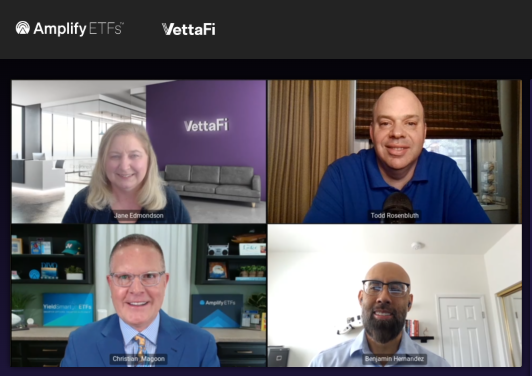
In a recent webcast, founder and CEO of Amplify ETFs, Christian Magoon, described it as a way for investors to “ease into energy,” with a built-in cushion from option premiums and dividends — something that can help offset the sector’s well-known volatility.
A “3-Engine” Total Return Approach
At its core, NDIV is built around three sources of return: price gains from energy and natural resource stocks, dividend income from cash-generating companies, and option premiums from a covered call strategy.
That mix reflects Amplify’s broader YieldSmart approach, which focuses on total return rather than chasing yield for its own sake. The fund is targeting annual income of 10% or more, with roughly 7% coming from dividends and another 3% to 6% from options.
It also takes a more measured approach to covered calls. Instead of writing options on the entire portfolio, NDIV typically covers about half of its holdings and sets strike prices modestly above current levels. The idea is to keep some room for upside while still generating a steady stream of income.

See More: Amplify ETFs Offer Unique Angles on Income, Thematics
How Advisors Are Using NDIV
In the webcast, three common use cases stood out for how advisors are putting NDIV to work in client portfolios.
- Adding another layer to income
NDIV can sit alongside more traditional income holdings like bonds, REITs, or dividend stocks. Because it draws income from both dividends and option premiums, it introduces a different kind of yield — one that isn’t as directly tied to interest rate moves.
- A more measured way into energy
For clients hesitant about the sector’s volatility, NDIV offers a softer entry point. The income from options and dividends can help cushion downside — Magoon puts that buffer at around 10% — making it an alternative to more directional energy ETFs that rely mainly on price gains.
- Income with a real asset tilt
With a sizable allocation to oil and gas, along with some exposure to chemicals and energy services, NDIV gives investors access to real assets that tend to respond to inflation. For advisors thinking about inflation-aware portfolios, it can play a role as an income-generating piece of that allocation.
Portfolio Positioning & Performance
The funds portfolio is largely concentrated in North America, with about 81% allocated to U.S. and Canadian companies. While energy is the core, the exposure isn’t limited to upstream names. Roughly 21% sits in chemicals, with another ~13% in equipment and services, giving the fund broader reach across the resource value chain.
That mix has supported its dual mandate of income and growth. In the first quarter of 2026, NDIV posted a total return of 36%, benefiting from both strong energy markets and the added contribution from its options strategy.
Tax Considerations
Tax treatment is another piece drawing advisor attention. Some of the income generated through options may be classified as return of capital, which defers taxes by lowering an investor’s cost base rather than creating immediate taxable income. For higher-income clients in particular, that can improve after-tax results.
Balancing Income & Growth
As Magoon put it during the webcast, the aim isn’t to chase yield at all costs, but to find a workable balance. “We’re trying to be smarter by having a balance between capital appreciation and attractive income so that you focus on total return,” he said.
In that sense, NDIV reflects a broader shift in how option-based strategies are being used. Rather than serving as pure income tools, they’re increasingly being positioned as part of a more balanced, total-return approach, something advisors are leaning into as markets remain uneven.
For more news, information, and analysis, visit The Thematic Investing Content Hub.
VettaFi LLC (“VettaFi”) is the index provider for NDIV, for which it receives an index licensing fee. However, NDIV is not issued, sponsored, endorsed, or sold by VettaFi, and VettaFi has no obligation or liability in connection with the issuance, administration, marketing, or trading of NDIV.
