
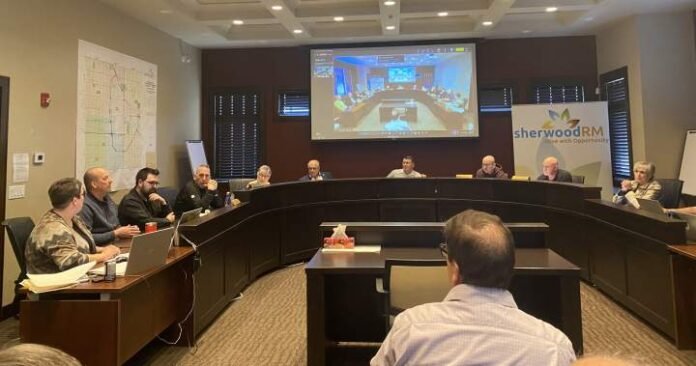


At times, it felt like the building was under siege. The development agreement for Bell’s 300 mega-watt Data Centre was approved by RM of Sherwood council Monday night. The proceedings were hectic, but moved quickly. Stopping and starting several times – it was difficult to hear delegates or councilors as they were often drowned out by protesters chanting outside, banging on windows, and honking horns. Still, the review, and the motion to carry, took less than an hour.
Protesters outside the RM of Sherwood public office.
Andrew Kitchen/Global News
Prior to the meeting, around 100 protesters gathered carrying signs and chanting slogans. Also prior to the meeting, heavy equipment was spotted on the project site, moving large piles of dirt.
Heavy equipment seen at the project site of Bell’s AI Data Centre early Monday April 20th.
Andrew Kitchen/Global News
The public meeting was restricted to registered delegates, and only a few members of the media, due to limited seating. But that didn’t stop the protesters outside from influencing things inside.
RM of Sherwood Council after approving Bell’s AI Data Centre development agreement.
Andrew Kitchen/Global News
The atmosphere was charged with anxious energy. Within a few minutes, council asked for the police to be called, saying they couldn’t conduct the meeting under the noisy conditions. However, between the interruptions, meeting participants persevered and Dan Rink, the President of Bell Fabric AI kicked things off. He gave a brief presentation about the various economic benefits of the project, research opportunities, and efforts made to reduce impacts on neighbouring communities.
At this point the meeting was interrupted by incessant pounding on the Council Chambers door. A security guard was instructed to address it, which allowed an opportunity for someone outside to announce that the public broadcast on Microsoft Teams was not working. People outside the meeting were also attempting to record the proceedings with smartphones pressed against the glass of the Council Chambers front door.

Get daily National news
Get daily Canada news delivered to your inbox so you’ll never miss the day’s top stories.
When the Microsoft Teams issue was resolved, Dan Rink resumed his presentation, noting that the Data Centre’s cooling system will not draw on municipal water. He went on to explain that light and noise mitigation strategies are included in the project’s plans.
He also explained that the project had not triggered the formal process for an environmental impact assessment – which is something that the provincial NDP have recently been questioning.
NDP shadow minister of jobs and economy, Aleana Young, questioning why an environmental impact assessment was not completed, Friday April 17th.
Andrew Kitchen/Global News
There was also a second interruption where individuals outside Council Chambers complained that the audio on the Microsoft Teams livestream was not working. Global News was unable to confirm if, or when, that issue was resolved.
Doug McKell then stepped forward to speak as a representative of concerned landowners who live and own land directly adjacent to the construction site. He explained that the group was not opposed to the Data Centre. The group submitted 42 questions to the RM and Bell, and he said that 20 of those questions had been addressed – 20 withdrawn – and only 2 issues remained.
The group asked for 2 additional landowner wells to be included within Bell’s baseline well-water monitoring program, since all the wells tap into the same aquifer. Also, requesting that Bell explain, in writing, their methodology for measuring low-frequency tonal acoustics that often escape traditional noise mitigation techniques.
As soon as McKell was finished speaking, Bell Fabric AI President, Dan Rink, quickly seized the opportunity to commit to including the additional wells, and doing their due diligence to ensure the aquifer was not affected.
In an interview with Global News after the meeting, Rink said Bell would address the low-frequency tonal acoustics as well. “We will find the methodology that you know makes everyone feel satisfied that there won’t be sound beyond the property line.”
Just as the council was about to move for a vote on approval, two delegates raised their hands, wishing to raise additional concerns.Despite formally registering as delegates beforehand, they had not submitted formal requests to speak, and the council voted against hearing them out.
That sparked an emotional outburst from one of the two delegates – clearly frustrated with the process – who said, amongst other things “I know what is happening here. You are fast-tracking this and avoiding every single person outside of this room.”
As she walked out of the room, she went on to shout “This is corrupt and I am disappointed. I don’t see a future for myself in this city with any of you … making decisions and I will leave. Have a good night. I am so sad to live here right now.” She concluded with an expletive and a plea for the council to listen to the people who live in the area.
The other outspoken delegate, who said she was from George Gordon First Nation and wished to speak about the importance of the requirement to consult, submitted her concerns in writing. She noted the tense atmosphere, saying “It’s scary in here,” before leaving.
After the interruptions, council asked if all parties were happy with the development agreement as presented. There were no objections. A motion was made to approve, and with the councilors quickly raising their hands, the motion carried.
As the group of concerned landowners filed out, they were met with shouts and accusations from protesters of being paid off, which Doug McKell expressly refutes.
“That’s absolutely ridiculous. Nobody in our group would do that and we were just wanting to have our concerns heard and they were documented through the agreement.”
Doug McKell’s family has lived and owned land in the RM of Sherwood for close to 150 years.
Andrew Kitchen/Global News
After participants had left the council chambers, Global News spoke with President of Bell AI Fabric, Dan Rink. “Of course, we’re really happy” he said “We’re building an ecosystem for AI adoption in Canada in partnership with government, First Nations, and Universities across the country, including here in Saskatchewan.”
President of Bell AI Fabric, Dan Rink, after AI Data Centre development agreement approved by council.
Andrew Kitchen/Global News
Bell’s rezoning application for the project site was approved in 21 days. The approval of the development agreement took 19 days. Several experts have told Global News that sort of timeline is nearly unprecedented.
Andrew Sancton, professor of municipal politics at the University of Western Ontario, said “That’s a very fast timeline. In my experience, I’m not familiar with anything remotely being approved that quickly”
But Rink disagreed, saying “Often in rural areas and small towns you can build fast. I built a facility in Merritt that was just as fast. We chose to partner in Saskatchewan… because Saskatchewan is a province who still knows how to get things done quickly.”
Rink also said that Bell would be conducting additional well-testing over the next week, while the building permits are processed. Formal construction will likely begin in early May.