
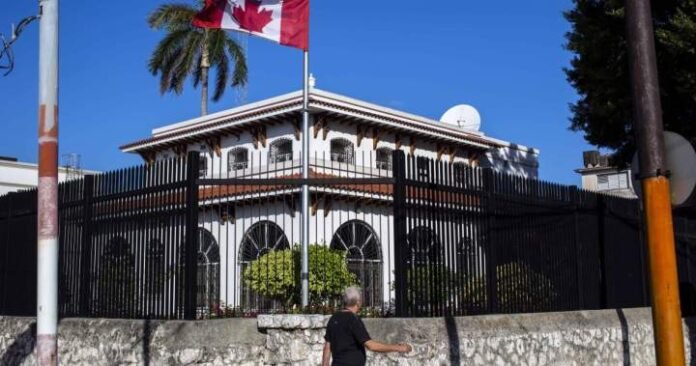


The federal government is standing by its conclusion that the mysterious illnesses known as “Havana syndrome” were not caused by an attack by a foreign actor, despite U.S. officials acknowledging that their own, similar conclusions were based on “flawed” intelligence.
The statement from Global Affairs Canada was given to Global News on Friday, a day after the leaders of America’s top intelligence and law enforcement agencies unanimously testified to Congress that the U.S. intelligence community’s assessments should be retracted.
Global Affairs Canada’s 2024 report into what it called “unidentified health incidents” experienced by Canadian diplomats serving in Cuba cited one of those U.S. assessments from 2023, which concluded it’s “very unlikely” a foreign actor was behind the debilitating symptoms that also struck hundreds of U.S. foreign service and military personnel abroad.
The Canadian report similarly said the incidents “were not the result of a malicious act of a foreign actor” and that pre-existing medical conditions, environmental factors and conventional illnesses “were likely to have been important factors in many of the symptoms experienced.”
“GAC stands by its 2024 report … which concluded that no definitive common cause could be identified for the health symptoms experienced by employees and their dependants in Havana,” department spokesperson John Babcock said in an email.
“We recognize the impact this issue has had on our employees and their families, as well as on the broader GAC and partner department communities. GAC remains committed to assisting staff members and dependants impacted by any health symptoms, with employee and dependant well-being remaining a departmental priority.”
More than a dozen Canadian diplomats and family members are suing the federal government after they say they experienced symptoms such as headaches, memory loss, mood changes, vision problems, nausea and nosebleeds in Havana beginning in early 2017.

The lawsuit — which remains unresolved seven years after it was first filed in 2019 — alleges Ottawa failed to protect the victims, hid crucial information and downplayed the seriousness of the risks. The government has denied negligence and wrongdoing.
The plaintiffs’ lawyer, Paul Miller, told Global News in a recent interview that the department has not followed up with victims — including children — and has questioned the way the Canadian investigation was handled.

Get breaking National news
Get breaking Canada news delivered to your inbox as it happens so you won’t miss a trending story.
“I have never believed one thing Global Affairs has told us,” Miller said.
“We have always thought from our perspective, from council’s perspective, that Canada could not come out and do anything or say anything without the U.S. first…. Because if it was a foreign actor that did this, it is an act of war.”
U.S. intelligence under scrutiny
During a hearing Thursday at the U.S. House Intelligence Committee, chairman Rep. Rick Crawford said the intelligence underlying the U.S. assessments was “flawed” and that agencies including the CIA and U.S. National Institutes of Health manipulated evidence to achieve a desired outcome.
“Put simply, it’s my clear opinion that individuals in the intelligence community were involved in a coverup,” he said.
Asked by Crawford if the latest U.S. intelligence community assessment from last year should be retracted, U.S. Director of National Intelligence Tulsi Gabbard — whose office is conducting a review of the investigation — said “yes.” Officials including CIA Director John Ratcliffe and FBI Director Kash Patel agreed.
Crawford’s committee released a report in December 2024 that concluded it is “increasingly likely” a foreign adversary is responsible for “some portion” of the incidents.
On Thursday, he cited recent media reports that have found an alleged link between Havana syndrome and Russia.
A 60 Minutes investigation this month alleged a covert device created by Russia may be behind the incidents, and that the U.S. government has acquired such a device and tested it on U.S. soil.

Babcock said the Global Affairs Canada report “followed years of exhaustive investigations into the reported incidents and symptoms” by the RCMP, the Nova Scotia Health Authority and brain health researchers at Dalhousie University, along with an environmental assessment and “collaboration with studies led by the U.S. government.”
The report makes no mention of testing that was being done at the University of Pennsylvania Center for Brain Injury and Repair, which the Canadian lawsuit says was testing American victims as well as Canadians in 2017.
The lawsuit alleges Ottawa used U.S. diplomatic channels to tell the Pennsylvania researchers to “stop the testing of Canadians,” which Miller said was due to “national security reasons.”
What did the Canadian report say?
The report outlines the steps taken after a multi-agency Integrated National Security Enforcement Team, led by the RCMP, opened an investigation in June 2017.
Global Affairs and RCMP officials began travelling regularly to Cuba as part of the investigation to look at the possibility of malicious attacks, the report says. Canadian officials also shared information with foreign partners, including the U.S.
In 2019, instruments designed to detect and capture evidence of acoustic and radiation surges, and to measure environmental effects — such as temperature, humidity, barometric pressure and ozone levels — were installed in the living quarters of Canadian staff in Havana.
“The data collected from the instruments did not provide relevant and probative information to identify a cause for the symptoms,” the Global Affairs report says. “As such, in 2022, the instruments were removed.”
The integrated national security team concluded “there was no criminality and no evidence attributing these health symptoms to a foreign actor,” the report adds.
“In their conclusions, the RCMP and other domestic partner agencies assess that there is no known criminality, no known attribution for (unexplained health incidents) and no patterns related to symptoms, age, gender, location, or other variable.”
The RCMP indicated that “since no criminality was uncovered, its criminal investigation would be concluded,” and CSIS advised it also would be wrapping up its investigations for similar reasons, the Global Affairs report says.
Overall, the Canadian efforts “have not uncovered a clear common cause of the symptoms experienced by government of Canada employees,” the report adds. “Canada’s findings are aligned with the conclusions of the United States on their various health studies and the security report published by the National Intelligence Council.”
— with files from The Canadian Press