

Summary
- Canada’s long-term strategy to expand into Asian markets is advancing rapidly, backed by supportive federal policies and closer strategic cooperation with Asian economies.
- With oil and NGL production hitting record highs, the federal government’s new Major Projects Office is prioritizing critical energy infrastructure approvals.
- Rising production and export volumes are contributing to moderate, long-term adjusted EBITDA growth for Canadian midstream corporations, albeit the large Canadian midstream companies have notable footprints in the U.S.
Canada’s energy market has long been pipeline constrained and particularly dependent on the U.S. However, additional infrastructure is providing new outlets for Canadian energy. A shift toward Asian markets has been realized through the ramp-up of the Trans Mountain expansion and the startup of LNG Canada. Learn more below about the impact of these projects and why the resulting production growth is supportive for Canadian midstream.
Canadian Crude and NGL Exports Target Asian Demand
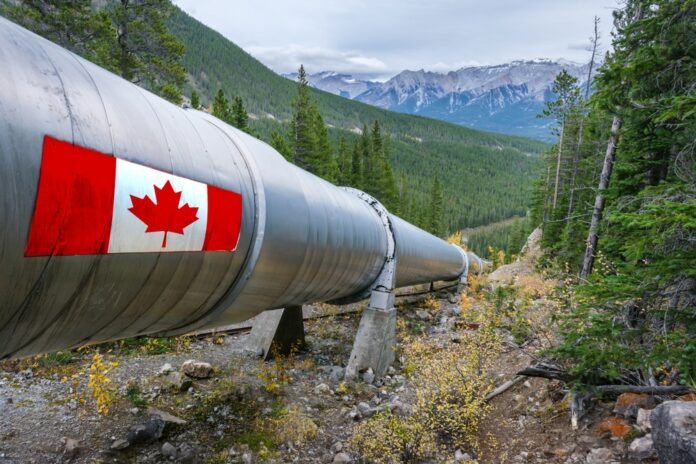
Canada’s government-owned Trans Mountain pipeline has provided an enhanced outlet for Canadian crude. The system’s capacity was increased from 300 thousand barrels per day (MBpd) to 890 MBpd in May 2024. Trans Mountain transports heavy crude, refined products, synthetic crude, and light oil from Alberta to Canada’s western coast, near Vancouver. From there, volumes can be directed to the Puget Sound Pipeline (which heads south into the U.S. with up to 240-MBpd of capacity), Sunoco’s (SUN) 55-MBpd Burnaby Refinery in British Columbia, and the Westridge Marine Terminal. Westridge is Canada’s only West Coast crude export facility with a capacity of 630 MBpd.
The Trans Mountain expansion has driven an increase in Canadian exports to non-U.S. markets from 112 MBpd in February 2024 to 549 MBpd by November 2025. The incremental exports are largely going to Asia. Refinery closures in California (read more) have also contributed to the shift of Canadian crude exports towards Asia.
Last week, Trans Mountain formally applied to execute its first optimization project. Drag Reducing Agents are expected to increase flow rates by up to 10% (~90 MBpd). This $9 million project is expected to add capacity by January 2027. Further ahead, Trans Mountain is assessing new pumping stations that could add another 360 MBpd of capacity within five years. This is now supported by the British Columbia government after years of opposition.
The importance of diversifying Canada’s crude trade was highlighted by its trade war with the U.S. in 2025, which saw the brief imposition of a 10% tariff on Canadian energy. The U.S. subsequently clarified that energy products would be exempt due to compliance with the USMCA. Most recently, Canada negotiated a preliminary trade deal with Beijing in January, which set a target to increase overall Canadian exports to China by 50% by 2030 (not just energy). For context, the U.S. remains Canada’s dominant energy trading partner. For example, the U.S. imported ~4.1 million barrels per day (MMBpd) of Canadian crude in 2024, compared with China’s peak imports of ~354 MBpd in March 2025.
With improved takeaway capacity, Canadian oil production reached a record high in late 2025. The IEA projects a 1.7% increase in Canadian oil production in 2026 as shown below. Natural gas liquids (NGL) production has likewise hit new highs, creating opportunities for midstream. Of note, AltaGas (ALA:CAQ) and Vopak (VPK:AEX) are constructing the Ridley Island Energy Export Facility (REEF) to meet rising Asian demand for propane and butane. The terminal is designed to export 55 MBpd of NGLs to Asian markets and is expected to be completed by the end of 2026. Midstream player Keyera (KEY:CAQ) has contracted for 25 MBpd of REEF’s export capacity under 15-year tolling agreements.
To support major new infrastructure, the federal government passed the Building Canada Act in June 2025, establishing the Major Projects Office (MPO) to fast-track critical infrastructure by coordinating federal, provincial, and Indigenous reviews into a single “one project, one review” process. Following a recent agreement with Alberta, the federal government has committed to prioritizing Alberta’s West Coast Oil Pipeline, a proposed pipeline from Alberta to the Northwest coast of British Columbia with a capacity of at least 1 MMBpd. The project, which would support a new deep-water crude export facility, has scheduled a formal submission to the MPO for July 2026 to kick off the review process.
Canada Expanding Global Liquefied Natural Gas (LNG) Exports
The most significant development of the last year is Canada officially becoming a global LNG exporter. LNG Canada loaded its first cargo on June 30, 2025, marking a historic milestone (read more). By November 2025, Train 2 entered production, and the terminal has since shipped over 25 cargoes. Smaller projects Woodfibre LNG and Cedar LNG, backed in part by Canadian midstream players, remain under construction and will add to Canada’s LNG exports in the coming years as shown below.

The MPO has set its sights on future LNG projects, designating the 1.6 billion cubic feet per day (Bcf/d) Ksi Lisims LNG project and 1.8 Bcf/d LNG Canada Phase 2 as “projects of national interest.” Canadian LNG projects are particularly well positioned to meet growing Asian LNG demand (read more). Ksi Lisims is expecting to reach its Final Investment Decision (FID), its formal commitment to begin construction, in early 2026.
Why Growth Matters for Midstream
Canadian companies are a key component of the North American midstream landscape and often operate significant assets in the U.S. TC Energy (TRP) even has assets in Mexico. South Bow’s (SOBO) Keystone crude system from Alberta to Houston is just one example of the integration between Canadian and U.S. markets.
As midstream investments, Canadian companies have typically been more defensive and less sensitive to fluctuations in crude prices. Their strong dividend track records also contribute to their defensiveness. Canadian companies represent 26.7% of the Alerian Midstream Energy Select Index (AMEI) as of February 5.
As shown below, key Canadian midstream names have provided long-term guidance for adjusted EBITDA growth. Visibility to growth is a clear positive for these names. For its part, Pembina (PPL:CAQ) plans to extend its long-term growth guidance for the post-2026 timeframe in 1Q26 following the advancement of certain key growth initiatives. Rising Canadian production and exports can contribute to this growth as exemplified by KEY’s NGL export agreement. Similarly, as discussed above, ENB and PPL are directly investing in LNG export projects, while TRP’s Coastal GasLink supplies LNG Canada and will supply Cedar LNG via a connector pipeline.
To be fair, Canadian production and export growth help. However, the opportunity set is not limited to Canada. Two-thirds of ENB’s C$30 billion investment program is allocated to the U.S. Meanwhile, most of TRP’s capital backlog is likewise directed to the U.S. due to higher risk-adjusted returns.

Canadian producers and midstream names briefly sold off in early January on concerns that Venezuelan barrels could displace Canadian heavy oil. However, pipelines from Canada are highly contracted. For example, SOBO’s EBITDA is 90% contracted (read more).
Bottom Line
Canada will increasingly be a major global energy exporter, particularly to Asian markets. With the federal government now actively fast-tracking new energy infrastructure projects, the outlook for Canadian energy production and exports remains constructive. For investors, Canadian midstream companies offer defensive qualities, solid dividend track records, and clear long-term growth targets.
Looking for midstream insights in your inbox? Subscribe here to keep a pulse on midstream investing through our weekly updates.
AMEI is the underlying index for the Alerian Energy Infrastructure ETF (ENFR) and the ALPS Alerian Energy Infrastructure Portfolio (ALEFX).
Related Research
Addressing Questions on Oil, Geopolitics, & Midstream
2026 EBITDA Guidance Reinforces Midstream Stability
Canadian Production Growth to Benefit Midstream
CA Refinery Closures Spur New Pipelines
Canada Enters LNG Export Market as First Facility Prepares for Shipment
Canadian LNG Projects Advance to Meet Asian Demand
vettafi.com is owned by VettaFi LLC (“VettaFi”). VettaFi is the index provider for ENFR and ALEFX, for which it receives an index licensing fee. However, ENFR and ALEFX are not issued, sponsored, endorsed, or sold by VettaFi. VettaFi has no obligation or liability in connection with the issuance, administration, marketing, or trading of ENFR and ALEFX.
For more news, information, and analysis, visit the Energy Infrastructure Content Hub.
