



Like a once-forgotten tune’s rediscovery, the thematic ETF theme could be poised for a comeback. One fund investors should listen to is the MUSQ Global Music Industry Index ETF (MUSQ), which could add a growth component to an investor’s portfolio.
High-momentum names propelled by the AI theme mostly encapsulate the growth factor these days. However, there are more growth options than the Magnificent Seven. Investors can inject their own personal passions, including music, into their investing themes.
“Thematic ETFs like MUSQ can help investors express views related to their own interests and hobbies, which can complement core holdings while adding a personal touch to a portfolio,” said Roxanna Islam, TMX VettaFi head of sector and industry research. Islam joined MUSQ founder and CEO David Schulhof, as well as TMX VettaFi head of index product strategy Jane Edmondson, for a deep dive on MUSQ and the music industry in a webinar.
A $200 Billion Market
To grasp the size and scale of the music industry, research from Goldman Sachs forecasted that it could reach $200 billion in 10 years — almost double the size of its 2024 valuation of $105 billion. Despite the challenges and uncertainty in the broad market, growth projections remain resilient.
A “a mix of structural, cyclical, and one-off factors” hampered growth in 2024. Nonetheless, analysts at Goldman Sachs “still think the industry has significant scope to increase in value, even if growth is slower than initially anticipated.”
Based on Goldman Sachs figures, MUSQ is poised to capture a portion of that 2x growth by 2035. As the report mentioned, legacy revenue drivers like sales and concerts will remain. Additionally, new revenue drivers will be dispersed among streaming markets, evolving music monetization models, video, and fervent music consumers or “superfans.”
Emerging Markets Growth
As mentioned, music streaming seems likely to be a prime revenue driver, typically measured in subscription growth. In times of persistent, sticky inflation like now, music is a cost-effective form of entertainment.
As Goldman Sachs mentioned, consider that the average monthly spend for a music subscription account is $14. Compare that to $69 for streaming video and “Netflix and chill” starts to look like an expensive proposition.
Given this, subscription growth is projected to be strongest in emerging markets (EM). Forthcoming rate cuts are pushing down the U.S. dollar. This could mean EM consumers will have more discretionary income to spend on music. Goldman Sachs analysts said that EM accounted for 8% of subscribers. However, that is forecasted to grow to 14% in 10 years.

Muted Response of AI
It’s difficult to discuss any market without AI as part of the conversation. There were initial worries about AI being a music industry disruptor with the advent and eventual proliferation of AI-generated music supplanting artists on various streaming platforms.
A Forbes article highlighted how AI music could serve as a an amplifier for the music industry or a disruptor with the potential to “decimate its foundations.” It’s a wait-and-see topic for a later discussion, but thus far, the industry’s response seems muted.
“AI remains a key topic,” Goldman analysts noted. “What we’re seeing is a collaboration between music publishers and platforms to try to protect the interests of artists from the disruptions of AI.”
A Main Stage Performer
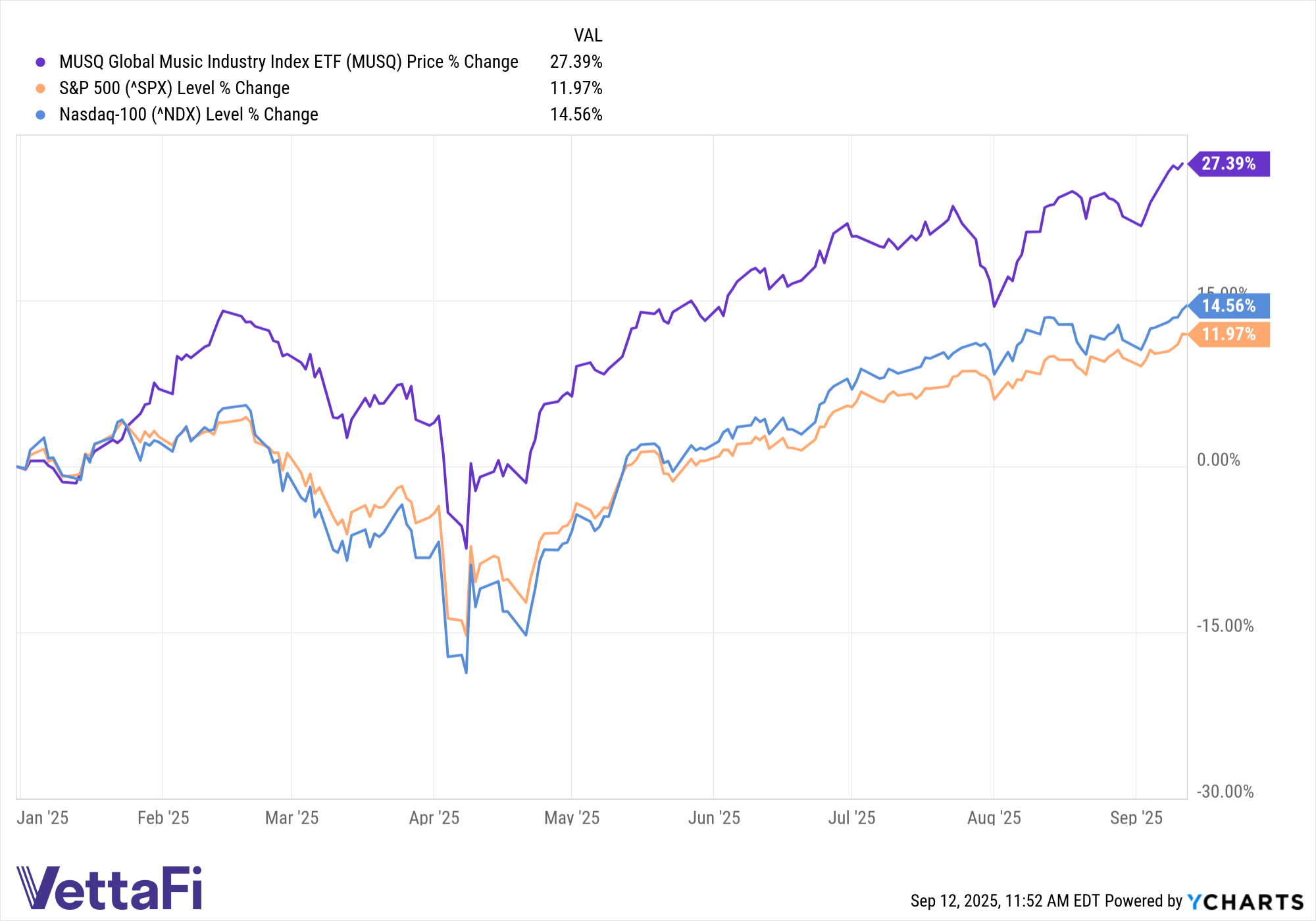
While MUSQ might be ideal as a side act in a portfolio, it’s performance has been worthy of the main stage thus far this year. Compared to the S&P 500, the MUSQ ETF is vastly outperforming, which proves that passion investing doesn’t mean sacrificing gains. To further punctuate its performance, it’s also besting the Nasdaq 100.
The fund offers easy ingress into the music industry, capitalizing on the strength of names like Live Nation Entertainment, Spotify, Universal Music Group, and Tencent Music by tracking the MUSQ Global Music Industry Index. It takes these industry movers and shakers then offers it in the convenience, flexibility, and tax efficiency of an ETF.
With a strong YTD performance combined with strong growth prospects, MUSQ is definitely a fund that could be music to investors’ ears.
For more news, information, and analysis, visit the Thematic Investing Content Hub.
